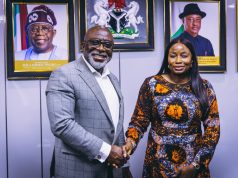
…bemoans massive deforestation in Nigeria
Posted by Sade Williams
For the umpteenth time, the Director General, Nigerian Meteorological Agency (NiMet), Professor Mansur Bako Matazu, has stressed the essence of collaboration among agencies, local, states and federal governments in reducing the risk of flooding in Nigeria.
Speaking on an NTA program monitored on Tuesday by The Travel Port, on state of preparedness to mitigate flood, along with Jigawa State governor, Umar Namadi, Prof. Matazu said many of the disasters associated with floods take place within communities and villages, adding that conerted efforts of all stakeholders were needed to tackle it headlong.
According to him, NiMet has issued its forecast early enough to government agencies, Ministries, departments and parastatals to get them prepared and plan ahead but stakeholders need to continue to work together at all levels to minimise risks.
“For us in NiMet, we issued our forecast early enough to give all the relevant MDAs and the three tiers of government enough time to prepare, integrate and to put all the information into planning purposes. And we did this precisely on the 24th of January and we also followed up and we have been doing updates on a monthly basis. We are also integrating additional impact-based forecast on a seven-day basis and every three day basis.”, he said.
Although, Matazu said compliance to early warnings and desisting from abuse of land use would go a long way in minimising the risk of flooding, he added that the cooperation among stakeholders would ensure prompt implementation of warnings, especially at the communities that are prone to flooding.
“So the summary of this year’s forecast as predicted earlier hasn’t changed, we are expecting a normal rainfall pattern here with pockets of abnormality, and along the line, after issuing the forecast in January, the sea surface temperature at the Central Equitorial Pacific Ocean swiftly changed to is called El-Nino, which is a factor that determines rainfall pattern in many parts of the world, including Nigeria, and this also will have implications on the focus. But we are still expecting a normal year with pockets of above normal in Borno, Yobe, Jigawa and parts of Kano.
“And most of the Central states are also going to have normal to a little bit above normal with pockets of below normal in the coastal areas but that’s not an implication beacuse they do have longer hydrological growing season. But the implication here is that we are begining to enter the active period and that is July to September.
“We ‘ve seen pockets of flash floods and the implication of El Nino is that there’s going to be increased temperature all over the globe and the moment you have warming of the atmosphere, you tend to have more convective activities which will trigger flash floods and that is what we have seen last week in Abuja. In a period of seven hours, we received 50 millimeters of rainfall in Abuja and that was what triggered the floods in Trademore and many parts of Abuja. “, he added.
While bemoaning deforestation as a major reason for environmental disasters, Matazu said, ‘a lot of land use dynamics happened in this country and one of it is deforestation and that is what is causing all the situations that his Excellency mentioned. About 400,000 hectares of trees every year lost in this country. I participated in a research but very unfortunate to mention that as a result of massive deforestation in Nigeria, presently, satellite pictures depict that extreme Northern Nigeria has less tree density species than extreme Southern Niger.
“When you look at floods, rainfall is just one factor, if we do not integrate and handle other components, the land use component, the compliance component and others, we still tend to have these floods.
” And we’ ve been crying for this, and is vertical collaboration between the central government at the federal level and the state government because most of these disasters happen at the last Mile and these are in the district and Local government areas.
“We have abundant information policy advisories at the federal level but we find it difficult at times, reaching out to states because during the release of our forecast which we deliberately did early in January so that we give five months time, we invited all the state governors plus 10 stakeholders in each state. We also tell state governors that our doors are open for collaboration so that what we do at the national level can be downscaled to state specific, ths will be linked with the Federal agencies’ forecast for that year
“But our main entry point is the state governors. We have always appealed to them, we visited the Nigeria Governors’ Forum three times, we’ve pleaded that during the induction course, NiMet and NISER should be included in the program so we can sensitize the new governors.”, he added.