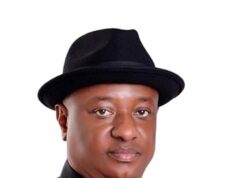
Mr. Damilola Emmanuel, Spécial Adviser to Lagos State Governor on Marine and Blue economy
Mr. Damilola Emmanuel, Spécial Adviser to Lagos State Governor on Marine and Blue economy has shed more light on the recently unveiled ‘Omi Eko’ project by the State government, saying what used to just be an idea and dream has now become a reality .
Recall that the State Government officially launched Omi Eko Project, a €410 million initiative aimed at transforming Lagos’ inland waterways into a world-class transportation system.
The project, according to Emmanuel in this interview on Creative Nigeria, a cultural tourism programme aired on Mainland 98.3 FM, Lagos, and hosted by award-winning journalists, Frank Meke and Bunmi Bade-Adeniji, represents a major step in Governor Babajide Sanwo-Olu’s plan to ease traffic congestion, improve mobility, and promote sustainable transport across Africa’s most populous city .
Excerpts :
About the project
Omi Eko project is a vision to be able to formalize the water transportation system in Lagos. The reason this is important is because Lagos is trying to ensure that other modes are fully built up and as you know that the road transport in terms of the BRT is advancing. You’ve seen what the current Governor has done with the rail, the red line and the blue line even with the green line which is coming up by the end of this year. With all of these going on, the water is the last Port missing of these three, we call it a three-point agenda integrated transportation in Lagos. Basically, the Omi Eko project is a local foreign funded initiative which will see the influx if over 70 hybrid electric ferries, you will also see the upgrade of 20 jetties and terminals, you will see the dredging of 140klm of the entire waterways of Lagos State , you will see capacity building for all stakeholders, implementing agencies and all stakeholders who are involved, you will also see a vessel industry transition program . Why this is important is that it’s for the informal sector to ensure they are not left out. It’s a six year project but we will be launching it in phases.
For now, it is still within the State , it’s such a big project such that if the opportunities become endless, there will be no reason why neighbouring countries cannot be accessed , we are looking forward to how that can also be explored because a lot of conversations are around that. You know the waterways have experienced lots of dreams, it’s no longer dreams now, we are seeing and living the dream. Initially, it’s for within Lagos but of course, we will provide opportunities for expansion.
Financing
The €410m investment is divided across three partners, the Agency for French Development, who is the main lead of the project, we also have the blended financiers , people who get involved with European Investment Bank and the EU, EIB and EU are loans accruing up to €300m but a grant is by EU, this is the largest grant EU has given to anybody in the world, they gave us €60m and Lagos State now gave a counterpart, €40m and there’s a €10m which is meant to be for the private sector. Remember that if we really want to transform the sector, we have to get it to where it should be. We get sensitive when we hear this large amount of money but it’s not when you think about what you are going to do and the impact it’s going to have on the people, you realise that it’s worth it and this is the kind of thing we need to consistently keep doing to get our waterways where it should be.
We have a moratorium of 7 years which gives government enough time to be able to do that , and of course, government knows that it’s an investment that cannot be funded alone by government , government will be willing to pay back from its own revenue , we believe that once the system is up a d running, there will be some funds that will be generated to sustain it and not to fund it alone and that is why the Federal government is guaranteeing this loan for the state.
Sustainability
The political will will always be there and secondly, stakeholders management, you can’t execute this kind of project without stakeholders, we’ve never had any ruffles with any association and that’s because we’ve been engaging them and we always found a way to resolve issues.
And thirdly it’s clear implementation strategy with milestones that has to be achieved as at when due.
Local content
They are Hybrid electric ferries, like diesel electric but this aspect will be fine tuned before the ferries start coming in before that time, the whole idea is going to be transfer of knowledge, for insurance, they are already piloting a numbers of electric busses. There’s a centre where the operators on all general transport stakeholders are being trained on the use of electric and how it works , so there’s a large capacity building for stakeholders , this is where a lot of operators will be trained, there will also be on the job training because this is the future, and we don’t want to leave anybody behind.
Climate change and healthy inland waterways
One thing about this Blue economy is that we need to set a clear vision, the state has been doing it, but obviously, strategic tourism is what the state needs to look at ,what are the numbers and how do we increase them, so Blue economy is something that has been existing for the longest time but I think now, it’s the next frontier , you have seen what the Federal government has been doing with Blue economy, setting a clear policy and that is the best place to start from and I believe that from the policy, you delve into implementation.
Most definitely, the inland waterways has served as a bedrock so that we can implement appropriately and of course, the whole idea is if we don’t have a healthy and clean waterways , there’s no way blue economy is going to thrive. We are engaging stakeholders and exploring partnerships that will enable us keep our waterways clean and healthy.