… over 18.8m passengers recorded in 2025
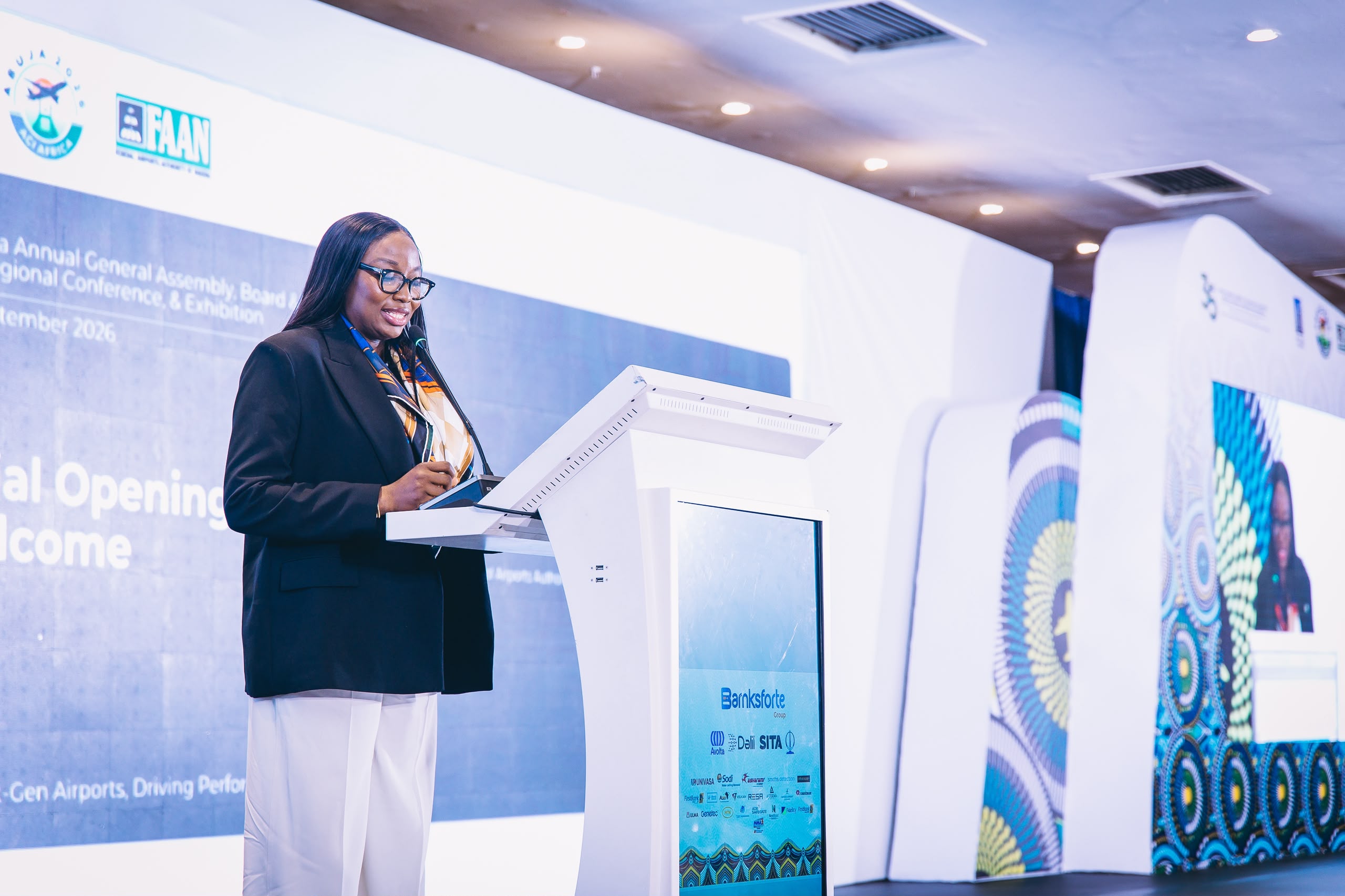
Nigeria’s aviation market now ranks as the fourth-largest in Africa, with over 18.8 million domestic and international passengers recorded in 2025, representing a year-on-year increase of 11.9 per cent, Managing Director, Federal Airports Authority of Nigeria (FAAN) and Vice President, Airport Council International Africa (ACI-Africa), Mrs Olubunmi Onabanjo-Kuku, has said.
She stated this in her welcome speech at the ACI Africa Regional Conference & Exhibition 2026 currently holding at the Abuja Continental Hotel, Abuja.
Speaking in the theme: ‘Next-Gen Airports: Driving Performance and Resilience, Odubanjo-Kuku said the theme is not merely a conference title but a strategic mandate.
“It is a call to action. It also reflects the journey we are collectively undertaking as a continent. Let me begin with the statistics that should give every one of us in this room confidence about where we are headed. According to the latest data from the International Air Transport Association (IATA), African airlines recorded a 6.4 per cent year-on-year increase in international passenger demand in July 2026”, she said.
Explain further, Odubanjo-Kuku said while global international demand actually declined by 0.1 per cent during the same period, Africa was expanding.
“We are not just participating in global aviation recovery—we are leading it. And I am proud to be standing in the same room with the men and women moving Africans and their visitors safely and in comfort. Our continent’s overall passenger demand grew by 5.2 per cent, second only to Latin America and the Caribbean, and substantially ahead of the global average of 0.2 per cent.
“This is not a marginal improvement. This continent is on the move. Nigeria, my home and the host nation for this conference, is proud to be at the forefront of this growth story. The Murtala Muhammed International Airport in Lagos—whose oldest terminal is being rehabilitated and upgraded as we speak—recorded the fastest growth in scheduled seat capacity among Africa’s ten largest airports in September, with a remarkable 24.1 per cent increase.”, she added.
Odubanjo-Kuku further revealed that according to OAG data, Nigeria’s total scheduled airline capacity for September 2026 reached 1.19 million seats, a 37.4 per cent increase from the same period last year—the fastest growth among Africa’s top ten aviation markets.
This, she said is driven by currency reforms, new aircraft leasing agreements, and growing confidence from international carriers looking to fly to Nigeria.
“These figures are not abstract. They represent millions of Africans connecting with family, doing business, accessing healthcare, and exploring opportunities. They represent livelihoods. They represent economic growth. They represent the future we are building together.
She however urged governments on the continent to confront the challenges beleaguering major growth of the continent.
“But let me be candid—as I have always believed leadership demands. Growth alone is not the full story. Africa’s aviation sector faces structural headwinds that we must confront with clear eyes and collective resolve.
“Our continent accounts for just 1 per cent of global air traffic despite having 18 per cent of the world’s population. Load factors remain below global averages, and our airlines’ financial viability remains fragile. In Nigeria alone, with a population exceeding 220 million, we record approximately 19.5 million passengers annually across 28 airports. The potential is vast, but the gap between where we are and where we could be remains substantial. This is not a reason for despair—it is a reason for deliberate, strategic action.”
According to Odubanjo-Kuku, the challenges are real, ranging from funding constraints, infrastructure gaps, high operating costs, fragmented connectivity, and the persistent pressure to keep charges low while delivering world-class facilities.
Dissecting FAAN’s journey since 2023, she said FAAN has learned that transformation is possible even under constraint.
On infrastructure modernisation, Odubanjo-Kuku said the Authority has prioritised safety and capacity, rehabilitated a major runway at the Murtala Muhammed International Airport, upgraded terminals, and improved airfield lighting while maintaining operations.
“We have focused on the fundamentals: safe runways, functional terminals, and reliable systems. On passenger experience, we have established the Passenger Experience Hub, a dedicated initiative to make speed, predictability, comfort, and human assistance central to our operations.
“We recognise that airports are not merely infrastructure—they are experiences. On digital transformation, we are deploying technology where it delivers measurable improvements. Fast check-in systems, automated e-passport gates, enhanced security systems, and passenger-data analytics are transforming how we operate.
On quality management, she disclosed that FAAN achieved dual ISO 9001:2015 and ISO 14001:2015 certifications in January 2026.
“This is not merely a certificate on a wall—it represents a systematic commitment to quality, environmental responsibility, and continual improvement. On human capital, we have invested substantially in training and professional development, with over 3,500 personnel reported as trained and certified through ICAO and ACI programmes.”, she added.