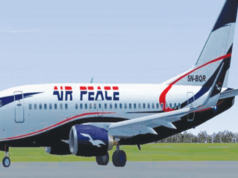
Major Energies Marketers Association of Nigeria (MEMAN) has denied claims that the price of Aviation Turbine Kerosene (ATK), also known as aviation fuel or Jet A1 is N3,300 per litre.
The marketers urged the Airline Operators of Nigeria (AON) to adopt sustainable pricing approach by entering into longer-term contractual arrangements with their suppliers, rather spot pricing.
The operators has threatened to shut down operations on Monday if the skyrocketing prices of the commodity is not checked.
It accused the marketers of deliberately frustrating operations and businesses by jerking up prices unnecessarily.
But imin a a statement signed by Clement Isong, Executive Secretary / CEO of MEMAN, the marketers said based on the survey they carried out yesterday, the claim by AON was false as the price is over N1,000 higher than the average market survey price.
“In light of the above, we must express our surprise at the price of N3,300 per litre stated in your letter as the price being charged to some airline operators. MEMAN members do not discuss pricing as this will be against competition law, however, the price of N3,300 is over N1,000 higher than our average market survey price of Jet Al carried out for this exercise, after receipt of your letter. We would therefore strongly encourage any operators currently being charged at those levels to exercise their commercial right to seek alternative suppliers.
“Our market survey confirms that more competitively priced options are available, and MEMAN members remain committed to providing ATK at fair, market-reflective prices. We have also received indication of falling costs, which should begin to reflect in market prices in the coming weeks.
“Finally, we strongly encourage AON members to adopt a more sustainable pricing approach by moving away from spot pricing and entering into longer-term contractual arrangements with their suppliers. This would provide greater price predictability, help stabilise cash flow, and reduce exposure to daily market swings.
Please be assured that MEMAN has been actively engaged with the relevant regulatory authorities on this matter.”, it said.
The association also explained the rigorous process it takes to distribute the commodity adding that it is more cost-intensive than other products.
“It is also important to note that the transportation and distribution of ATK is governed by specific protocols for quality assurance and safety reasons, which are more stringent than those applicable to most other petroleum products. Dedicated equipment, specialised handling procedures, and rigorous quality checks at every stage of the supply chain are non-negotiable requirements. These necessary safeguards inherently make the logistics and distribution of ATK a more cost-intensive undertaking compared to other petroleum products. We want this context to be clearly understood as part of any assessment of pricing in the sector.
“That said, we wish to assure you that reducing the cost burden of petroleum product distribution is a matter of active and ongoing attention within our Association. Steps to improve safety and simultaneously reduce logistics, delivery, and operational costs across the downstream value chain are continually being discussed, shared, and implemented between MEMAN members and the MEMAN Secretariat through regular webinars, training programmes, and industry engagements. It is a core part of our mandate to share these best practices broadly with the downstream industry so that distribution costs are minimised to the greatest extent possible, without compromising on safety or quality standards.”, it added.
Following due consultations, MEMAN said it has formally communicated several practical suggestions and recommendations aimed at mitigating the impact on the aviation sector and the wider economy.
“We continue to engage constructively with the Midstream and Downstream Petroleum Regulatory Authority ( NMDPRA) and other key stakeholders to find balanced and sustainable. We remain committed to working collaboratively with al stakeholders, including the Airline Operators of Nigeria, to ensure the long-term stability and growth of the downstream petroleum sector while supporting
critical national services such as aviation.”