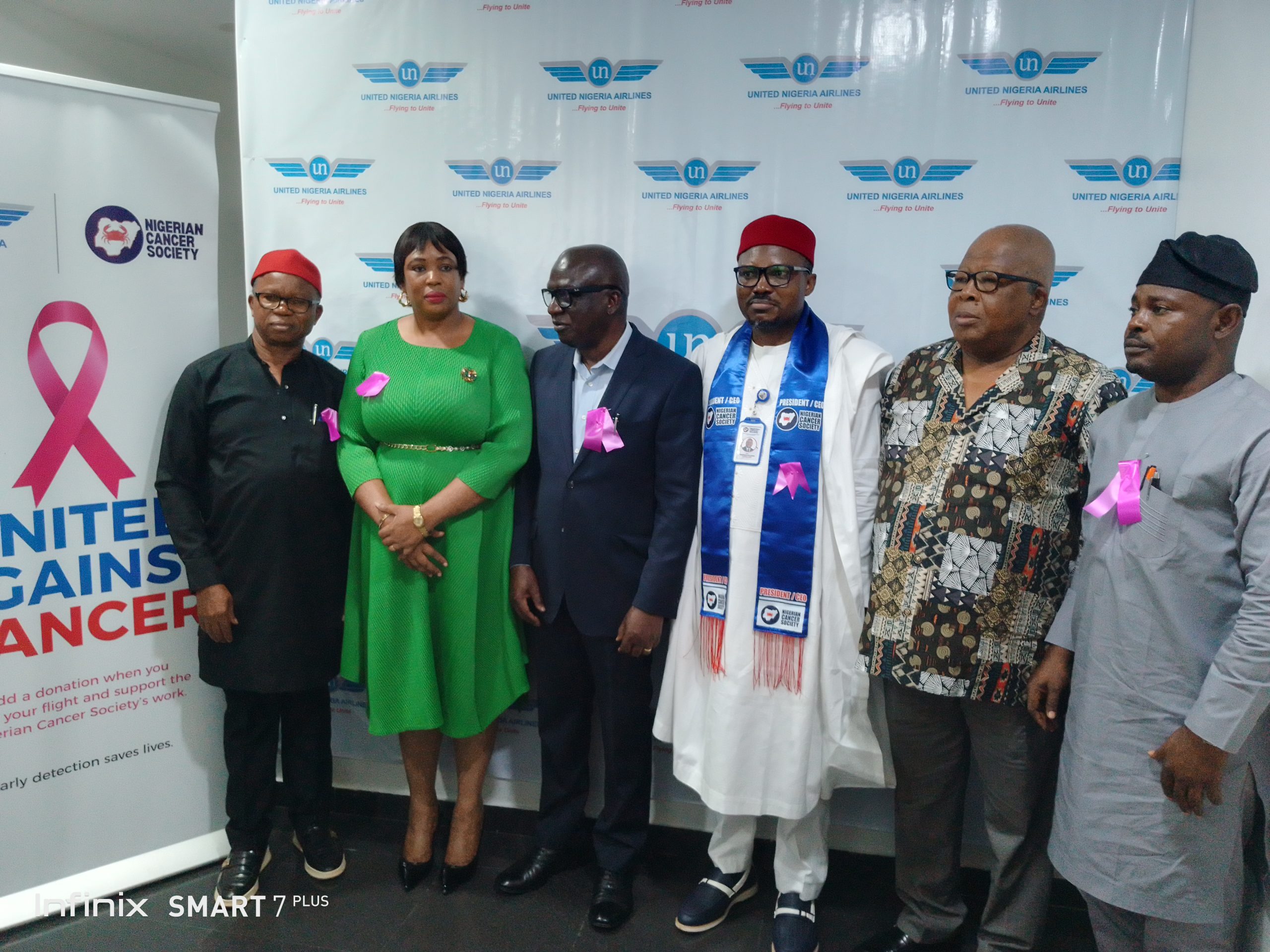
From left: Dr. Ukoma Theophilus; Dr. Tessy Ahmadu, Sec.Gen, NCS; Mazi Ositadinma Okonkwo, MD, UNA; Prof. Abidemi Omonisi, President, NCS; Mr. Columbus Okaro, UNA staff and Ajagun Olusegun Peter, Chairman, Lagos NCS during a briefing on the partnership between UNA and NCS on cancer awareness in Lagos on Wednesday
United Nigeria Airlines (UNA) has launched a foundation to improve cancer care in Nigeria through an onboard funding raising initiative. To give the initiative a national outlook, it has partnered the Nigerian Cancer Society (NCS) , with plans to create awareness on and boost cancer care across Nigeria.
The NCS is dedicated to eliminating cancer as a major health problem through prevention, advocacy, research, and training.
Explaining the nature of the foundation, and how it plans to raise funds for the cause, Managing Director of UNA, Mazi Ositadinma Okonkwo said passengers will book tickets the the option to make a voluntary contribution on the airline’s platform, adding that they can contribute as little as N1,000 and as much as N5,000 or N100,000.
Okonkwo, who said the donation is that is the first stage of the campaign, assured that the monies raised, all the donations raised, will go directly to the society or to an account designated by the society for this purpose of cause.
While appealing to Nigerians to donate to the cause, he said: “As a company, as individuals as staff members, I think some of us have stories to tell about cancer whether its direct or indirect we’ve seen the news, we’ve had the news we’ve seen people who have been affected by this deadly disease, and it’s based on that that United Nigeria has decided to work with the Nigerian Cancer Society
“We are very excited to work with Nigeria Cancer Society in mounting a united campaign against cancer in Nigeria as the name of the tbe airline implies. Today is a remarkable day for us. We have a unique and innovative way of raising funds from the passengers that fly with us on a daily basis , we have looked at the programmers and activities of the society and we are very happy with them. We believe that they need to be supported, not only by UNA through its foundation but through the passengers that fly with us. Its a a unique way, you book a ticket, you have the option of making a voluntary donations on our platform. form. You can do as little as 1,000, you can do as much as you want, 1,000, 2,000, 5,000,
“All the monies raised, all the donations raised, we go directly to the society, to an account designated by the society for this purpose of cause they are experts in the fight against cancer but our position is that to fight cancer you have to start from early detection”, he said.
Okonkwo noted that if a patient ailment is detected early enough, he stands a very good chance of being treated and becoming cancer free, noting that the concept of cancer being a deadly terminal disease is when it is not detected at the very early stage.
“So, our primary focus will be at the early stage prevention and massive campaign and information sharing so that’s the first level, the second level is of course, there may be people whose ailment will not not be detected at early stage and they will need treatment. Successful treatments have been have been recorded across board. This is also a personal matter to some of us line I have mentioned here that we have our own personal story, I am a cancer survivor too”, he said.
Also speaking, President of NCS, Prof. abidemi Omonisi said the body had been fighting cancer over sixty years, adding that it engages government and encourages organisations to rise to the fight against deadly disease.
While commending UNA for the bold step, he lamented infrastructure and funding gaps diminishing cancer care in Nigeria, adding that government lacks strong policy on cancer.
“Even the federal government does not even believe that there is actually cancer at the time it started. 60 years ago, a group of researchers in the medical department actually started it based on the experience in Western countries. But they fell that this disease is strange to us in Nigeria, but they started creating awareness about it. At that time, the federal government of Nigeria, they don’t believe in that. There’s no policy of cancer but the Society continues to make sensationalization to the government, to individuals, organisations but. when the federal government saw that this thing they are talking about is real they started cooperating.”, he said.
The NCS boss, who said their objective, basically, is cancer education, explained that “the cancer that we have is not the same as what they have in developed countries because they are white, we are black. So in terms of genetics, we are not the same. That’s why most of the treatment that they have in Western countries does not really benefit our people. Part of my training, I did my training in the UK and in our centre in Leeds, we’ve seen patients that have three cancers. By the time they are 87, they are still alive. three cancers? why because they generate drugs and those drugs are used to do that but we are black , we’ve not done enough studies on many drugs where actually research were conducted on the whites.
He spoke of the need for proper and continuous screening to aid early detection and treatment.
“Therefore, it means that none of those drugs we have minimal effect on our people so that’s why you said appreciate you know in our country just one cancer they are down in the middle of the therapy, none of them will survive but that’s the western country who have three or four cancers and they survive So, we’re actively involved in the science of cancer, because as I said, the society is actually funded by cancer researchers, so we’re actively involved in that. Screening is also part of what we do.
“Screening is very important because the only escape, of course that we have in developing countries is aggressive screening. You must be involved in screening. But if you screen, you pick up these cases early, and once you have any cases, there are a lot of things you can do in the country to actually save that patient.”, he added.